Education • 6 min read

By Bitpanda
17.02.2026
At times, Bitcoin seems to pull the entire crypto market along with it; at others, altcoins suddenly take center stage, significantly outperforming the flagship currency. For many investors, this raises the same recurring question: Which market phase is currently dominating, and why does leadership shift so regularly between Bitcoin (BTC) and altcoins?
A look at past market cycles reveals that these shifts are no coincidence. Instead, Bitcoin and altcoins follow recurring patterns closely linked to capital flows, risk appetite, and market sentiment. By understanding how these market phases function, investors can better interpret price movements – without overreacting to short-term fluctuations or drawing the wrong conclusions.
Key takeaways
The crypto market goes through recurring phases where either Bitcoin or altcoins take the lead.
Bitcoin typically dominates during defensive market phases, while altcoins tend to outperform when risk appetite increases.
Which assets perform better is rarely a matter of chance; it is driven by capital rotation, market sentiment, and liquidity.
The current market cycle traces back to November 2022. Following an all-time high of approximately €58,000 in November 2021, Bitcoin plummeted to around €15,500 – a drawdown of roughly 73%. While significant, such sharp corrections are not unusual for Bitcoin.
In previous cycles, we saw crashes of approximately -86% in 2014/15 and -84% in 2018/19. It is notable that these drawdowns from all-time highs have trended smaller over time, a pattern suggesting increasing market stability.
Following this bottom, a new upward trend emerged. However, this recovery was not linear. Instead, the subsequent market cycle can be divided into several distinct phases, each characterized by shifting leadership between Bitcoin and altcoins.
Phase 1 (2023): Bitcoin recovery without altcoin participation
From November 2022 through late 2023, Bitcoin completely dominated the market. While Bitcoin surged from €15,500 to nearly €39,000 (+151%), most altcoins lagged significantly behind. The Altcoin Season Index, which measures how many of the top 100 altcoins outperform Bitcoin over a 90-day period, remained largely below 30.
Phase 2 (Q1 2024): First selective altcoin movements
At the start of 2024, Bitcoin sat at roughly €40,000. During this phase, specific altcoin sectors began to perform, particularly Layer-1 blockchains and AI tokens. In March 2024, the Altcoin Season Index spiked for the first time in a long while, though it only briefly crossed the 75 threshold.
Phase 3 (Late 2024): Brief altcoin rally
In November 2024, Bitcoin’s relative strength weakened, briefly shifting the spotlight to altcoins. By December, the Altcoin Season Index peaked at 88, crossing the critical 75-mark. However, a sustained or broad-based "Altcoin Season" failed to materialize.
While individual assets like XRP, Cardano, and Solana posted significant gains, the majority of altcoins continued to underperform relative to Bitcoin.
Phase 4 (2025-2026): Return to Bitcoin dominance
Since the beginning of 2025, relative market strength has once again shifted heavily in favor of Bitcoin. The Altcoin Season Index dropped to extreme lows during this period, occasionally hitting levels around 12 – values historically rare that indicate pronounced Bitcoin dominance.
Although there was a short-lived spike in June 2025 where the index briefly rose above 75, this surge was fleeting and coincided with a period of heightened market euphoria surrounding new Bitcoin all-time highs. Since then, the Altcoin Season Index has retreated noticeably and currently sits at approximately 41 (as of February 2026).
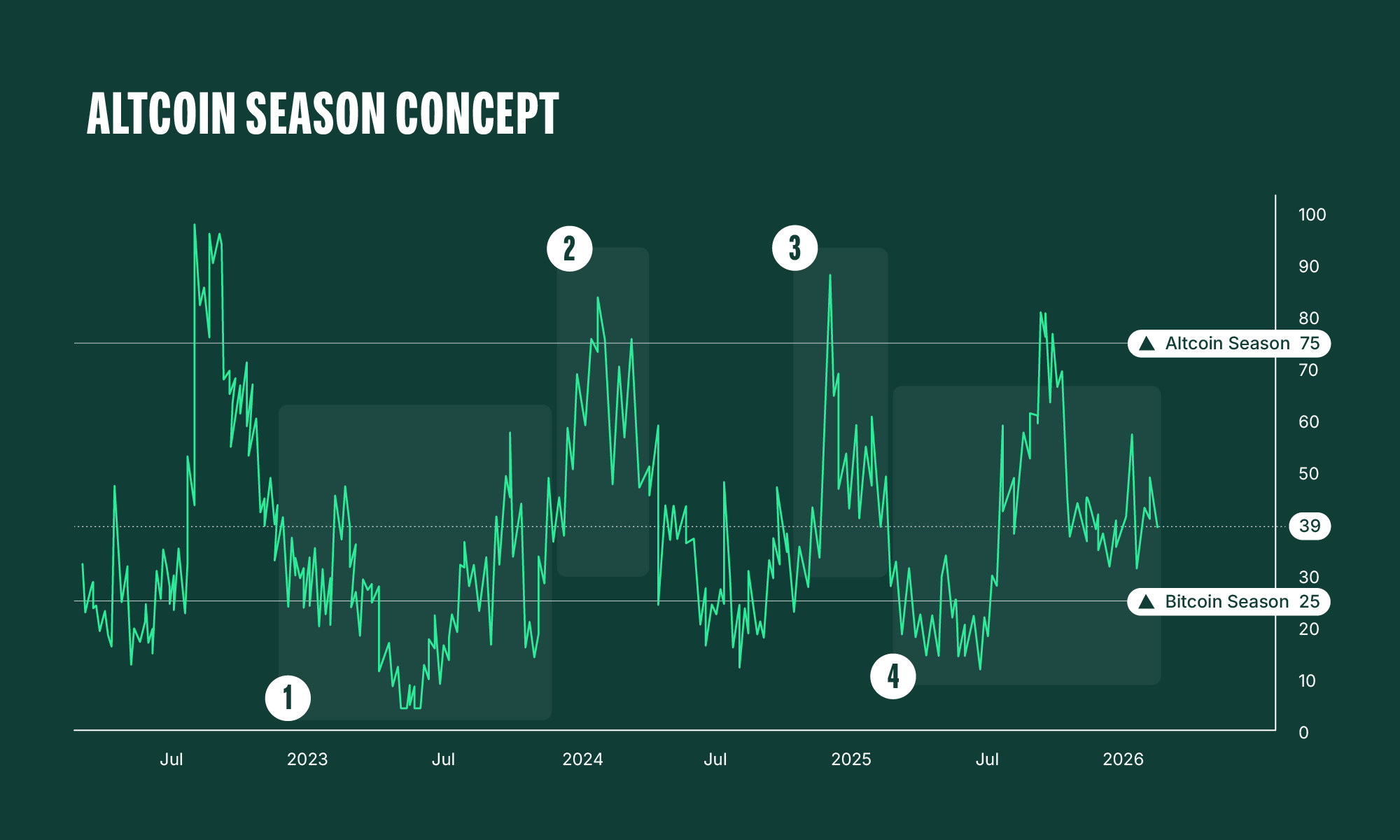
The trajectory of the Altcoin Season Index illustrates a systematic rotation: starting from deep Bitcoin dominance in 2023 (values below 30), moving through selective spikes in 2024, and leading to the current return to form in early 2026.
Over an extended period, no sustained altcoin outperformance has managed to establish itself. Instead, Bitcoin has once again dominated market movement, while altcoins have shown only isolated pockets of strength. This development highlights a market phase where capital remains heavily concentrated in Bitcoin and risk appetite remains constrained.
It is no coincidence that Bitcoin often spearheads new market cycles. Recoveries following major corrections typically begin with Bitcoin before altcoins follow suit. Three central structural factors can be identified for this:
1. High liquidity and market depth
Bitcoin is by far the most liquid asset in the crypto market. Large capital inflows, particularly from institutional investors, can be deployed efficiently here without causing extreme market distortion. Therefore, new demand initially concentrates on Bitcoin.
2. Perception as a relatively defensive asset
Within the crypto sector, Bitcoin is considered less speculative than most altcoins. In early recovery phases or following market crises, investors tend to prefer assets with lower relative risk before increasing their exposure to more volatile plays.
3. The established "digital gold" narrative
Bitcoin is increasingly perceived as a long-term store of value. This narrative gains significant traction during periods of macroeconomic uncertainty, reinforcing Bitcoin’s role as the primary entry point for capital entering the crypto market.
A central tool for categorizing this dynamic is Bitcoin Dominance, Bitcoin's share of the total crypto market capitalization. It indicates whether capital is primarily concentrating in Bitcoin or flowing increasingly into altcoins.
As of February 2026, Bitcoin dominance stands at approximately 58-60%. In volatile market phases, this high value reflects a clear "flight to liquidity": while the broader market corrects, altcoins often suffer disproportionate losses, which stabilizes Bitcoin’s relative market share.
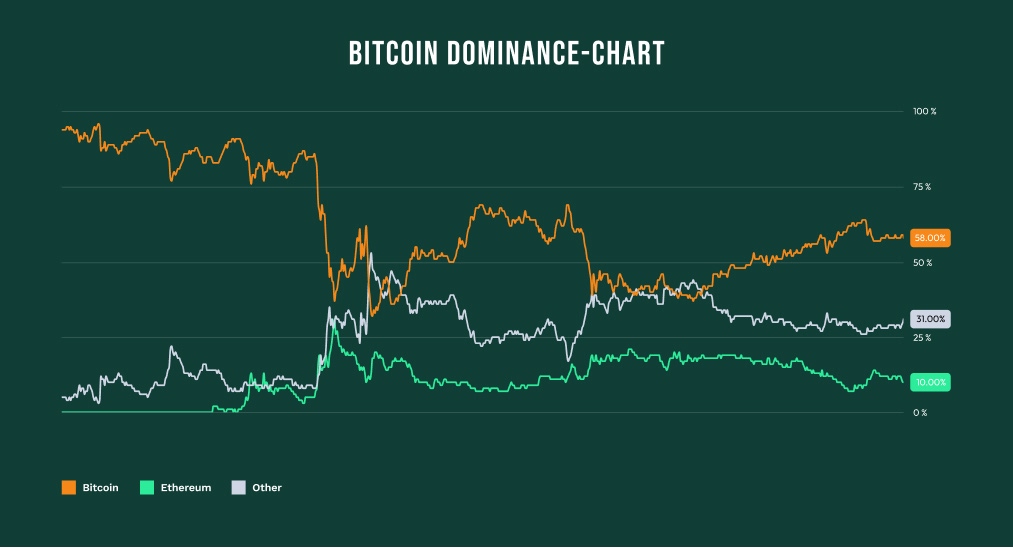
Market Share Comparison: This chart visualizes Bitcoin's long-term dominance relative to the total crypto market capitalization.
Historically, the 60% mark has acted as significant resistance; for traders, a sustained decline below this level is often viewed as a technical signal marking the beginning of a new Altcoin Season.
The relative performance between the flagship currency and the rest of the market is not static; it is closely tied to the specific market phase. Three characteristic scenarios can be observed:
In the early stages of a bull market, Bitcoin usually takes the lead as fresh capital flows first into the most liquid asset. Only during a period of consolidation at high price levels, when Bitcoin begins to trend sideways, does the rotation into altcoins begin. Due to their lower market capitalisation, altcoins often act as a levered play, capable of significantly outperforming Bitcoin in the short term.
In phases without a clear trend, the market often behaves selectively. While Bitcoin functions as a defensive anchor with decreasing volatility, interest tends to concentrate on specific niches (e.g., AI tokens or Layer-1 solutions). This leads to isolated pockets of strength rather than broad-based altcoin outperformance.
Falling markets highlight the protective nature of market depth. While Bitcoin also undergoes significant corrections, it often remains more stable compared to many altcoins. Because investors tend to liquidate speculative positions first during times of crisis, altcoins usually lose disproportionate ground during these windows.
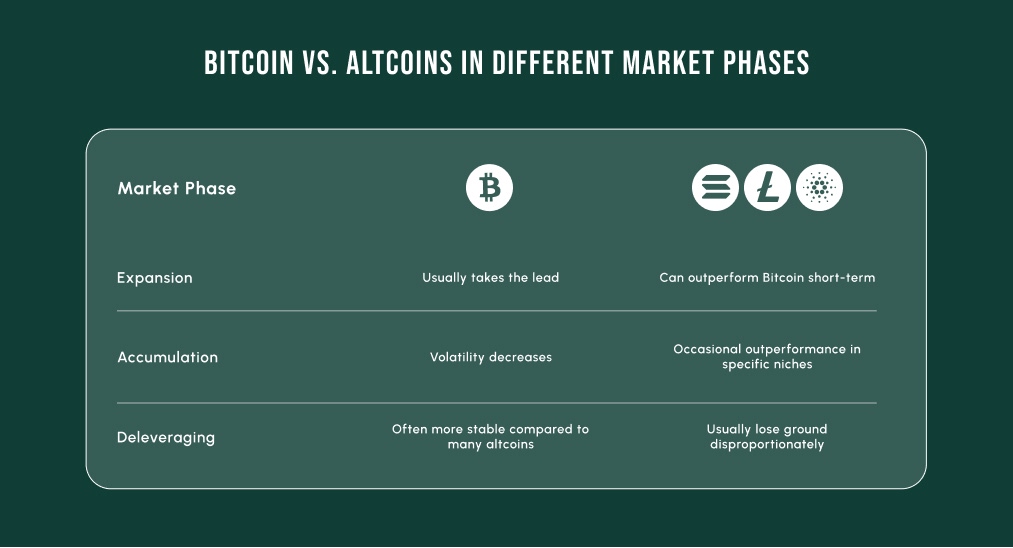
The analysis of market phases highlights one clear truth: there is no such thing as constant outperformance. Whether Bitcoin or altcoins take the lead is not a matter of chance; it is a direct result of current liquidity levels and the market’s appetite for risk.
Bitcoin as a defensive anchor: Especially during correction phases or early recovery cycles, the flagship currency provides a level of relative stability that altcoins often lack due to their lower market depth.
Altcoins as a lever on risk: During periods of high euphoria, when Bitcoin’s price tends to trend sideways, altcoins act as performance accelerators, though this comes at the cost of significantly higher volatility.
For investors, this means that portfolio structures do not have to be static; they can instead be guided by these cycles. Historical windows, such as Bitcoin’s dominance in 2023 or the altcoin rally in the first half of 2021, demonstrate that patience is often the decisive factor. Outperformance is never guaranteed and depends heavily on which phase of the cycle we are currently navigating.
Disclaimer
This article is distributed for informational purposes, and it is not to be construed as an offer or recommendation. It does not constitute and cannot replace investment advice.
Bitpanda does not make any representations or warranties as to the accuracy and completeness of any information contained herein.
Investing carries risks. You could lose all the money you invest.
We use cookies to optimise our services. Learn more
The information we collect is used by us as part of our EU-wide activities. Cookie settings
As the name would suggest, some cookies on our website are essential. They are necessary to remember your settings when using Bitpanda, (such as privacy or language settings), to protect the platform from attacks, or simply to stay logged in after you originally log in. You have the option to refuse, block or delete them, but this will significantly affect your experience using the website and not all our services will be available to you.
We use such cookies and similar technologies to collect information as users browse our website to help us better understand how it is used and then improve our services accordingly. It also helps us measure the overall performance of our website. We receive the date that this generates on an aggregated and anonymous basis. Blocking these cookies and tools does not affect the way our services work, but it does make it much harder for us to improve your experience.
These cookies are used to provide you with adverts relevant to Bitpanda. The tools for this are usually provided by third parties. With the help of these cookies and such third parties, we can ensure for example, that you don’t see the same ad more than once and that the advertisements are tailored to your interests. We can also use these technologies to measure the success of our marketing campaigns. Blocking these cookies and similar technologies does not generally affect the way our services work. Please note, however, that while you’ll still see advertisements about Bitpanda on websites, the adverts will no longer be personalised for you.