Enterprise • 6 min read

By Bitpanda
23.07.2026
Stablecoins offer capital-efficient opportunities for institutions to generate yield and streamline settlement through staking, lending, or issuing their own digital euro.
Stablecoins have evolved from a niche utility to a central pillar in the digital asset economy. Pegged to fiat currencies such as the euro or US dollar, they offer low-volatility exposure combined with high liquidity and programmability.
For institutions, stablecoins present an increasingly relevant instrument for generating yield, streamlining cross-border payments, and building digital money infrastructure. Whether through direct participation in decentralised finance (DeFi), or the issuance of a branded stablecoin, stable assets now play a critical role in both front- and back-office digital finance operations.
This article explores how stablecoins generate returns, where institutional demand is growing, and how Bitpanda Enterprise supports enterprise clients with regulated infrastructure, including the issuance of euro-backed stablecoins.
Stablecoins are digital tokens typically pegged to the value of a fiat currency such as the euro (EUR) or US dollar (USD). They are deployed on existing blockchains like Ethereum, Avalanche or Solana and are commonly used in trading, payments, and treasury operations.
Types of stablecoins:
Stablecoins provide interoperability between traditional finance and crypto infrastructure, while enabling fast, low-cost settlement and flexible capital deployment.
For institutions, the primary question is not whether stablecoins will appreciate in value but how they can be used to unlock returns, reduce friction and optimise capital allocation.
Common use cases include:
Let’s examine each in more detail.
Stablecoins can be deployed into liquidity pools on decentralised exchanges (DEXs), enabling efficient trading for other participants. In return, liquidity providers earn a share of transaction fees.
Example: An institution may supply liquidity to a USDC/DAI pool, earning passive yield while maintaining low volatility exposure.
Risks to consider:
Liquidity provisioning is suitable for institutions with robust risk controls and infrastructure for interacting with decentralised platforms.
While native Proof-of-Stake assets (e.g. ETH, SOL) are staked to secure networks, staking stablecoins typically involves locking them into a platform or protocol to earn rewards or interest.
Stablecoin staking enables institutions to:
Institutions with access to multiple venues can benefit from stablecoin arbitrage, which means profiting from price differences across platforms.
Example: Buy USDC at a slight discount on one exchange, sell at a premium on another.
Key success factors:
While arbitrage is not exclusive to stablecoins, the lack of price volatility makes them an ideal vehicle for market-neutral strategies.
Stablecoins are not designed for price appreciation , but they offer compelling advantages in capital preservation, yield, and liquidity management.
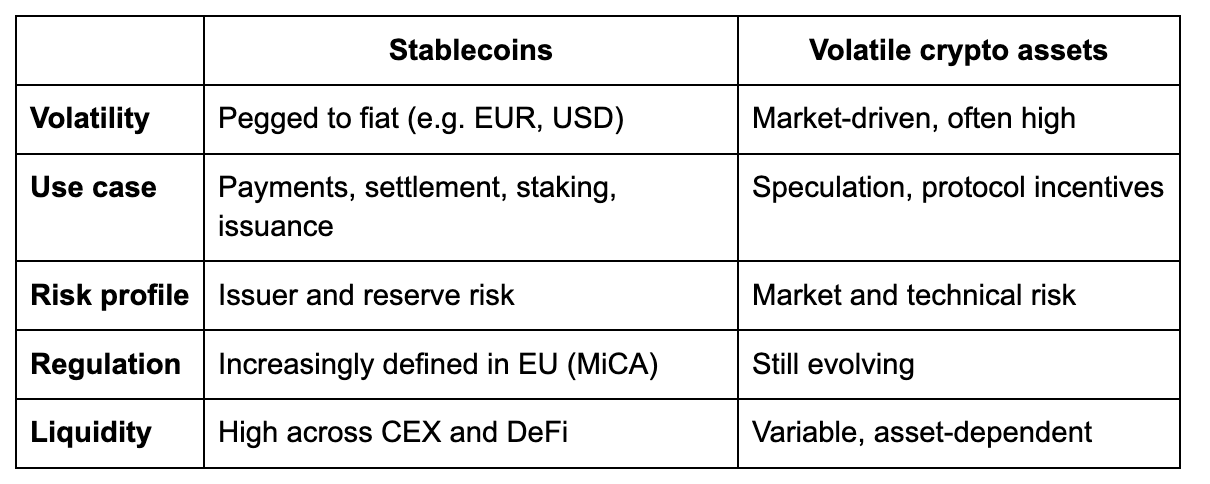
Stablecoin strategies are increasingly adopted by fintechs, neobanks, exchanges, and institutional investors for short-duration deployment and yield-generation use cases.
For many institutions, the next step is not just using stablecoins but issuing their own.
With Bitpanda Enterprise Stablecoin, banks, fintechs, and corporates can issue and manage a fully backed, euro-denominated stablecoin under a regulated infrastructure. The solution covers the entire token lifecycle:
Operating through a Malta-licensed entity, and aligned with MiCA, FCA, and VARA frameworks, Bitpanda Enterprise’s infrastructure ensures full transparency, compliance and operational scalability.
Whether for treasury digitisation, faster B2B settlement, or embedded crypto services, Bitpanda enables institutions to harness stablecoins as infrastructure, not just an asset class.
Here are stablecoins commonly used in institutional environments for yield generation, settlement, and DeFi integration:
Fiat-backed and audited monthly. One of the most widely supported stablecoins across CEX, DeFi, and custody providers. Popular for USDC staking and regulated use cases.
Decentralised and overcollateralised by crypto assets. Offers transparency through MakerDAO governance and wide usage across DeFi protocols.
Tokenised gold backed by allocated physical gold. Ideal for digital portfolios requiring commodity exposure without off-chain settlement.
A fiat-backed stablecoin issued by Paxos for PayPal. Primarily US-focused but gaining adoption for payment integration use cases.
With Bitpanda Enterprise, institutions can create and manage their own euro-backed stablecoin, with native support for regulated issuance, payment flows, and conversion — all under one infrastructure.
While stablecoins minimise price volatility, they are not without risk. Institutional teams should evaluate:
Ultimately, stablecoins must be treated as part of a broader risk and compliance framework, especially as they integrate deeper into enterprise workflows.
Stablecoins offer more than just a stable store of value. For institutions, they are a tool for liquidity, a vehicle for yield, and a bridge between regulated finance and blockchain infrastructure.
Whether through staking, arbitrage, or full-scale issuance, stablecoin strategies can help enterprises move capital faster, reduce settlement costs, and innovate on top of programmable money.
With Bitpanda Enterprise, institutions can go a step further by issuing their own regulated digital euro, embedding crypto payments, and managing the full token lifecycle with confidence.
Build the future of regulated digital finance on infrastructure you can trust.
Learn more or speak with our enterprise team.
Are stablecoin rewards taxable for institutions?
Yes. Income generated through staking rewards, arbitrage, or lending must be assessed for taxation based on jurisdiction. Institutions should work with tax and compliance specialists.
What determines stablecoin staking rates?
Stablecoin staking rates are influenced by market demand, platform terms, and protocol incentives. Institutions may access different rates based on size, duration, and risk parameters.
Can stablecoins be used as collateral?
Yes. Stablecoins are widely used as collateral in DeFi and institutional lending markets. They provide predictable value and are commonly accepted in overcollateralised lending structures.
Are stablecoins secure?
Security depends on the issuer, reserve model, custody solution, and smart contract integrity. Leading stablecoins like USDC offer high transparency and are subject to regulatory oversight.
We use cookies to optimise our services. Learn more
The information we collect is used by us as part of our EU-wide activities. Cookie settings
As the name would suggest, some cookies on our website are essential. They are necessary to remember your settings when using Bitpanda, (such as privacy or language settings), to protect the platform from attacks, or simply to stay logged in after you originally log in. You have the option to refuse, block or delete them, but this will significantly affect your experience using the website and not all our services will be available to you.
We use such cookies and similar technologies to collect information as users browse our website to help us better understand how it is used and then improve our services accordingly. It also helps us measure the overall performance of our website. We receive the date that this generates on an aggregated and anonymous basis. Blocking these cookies and tools does not affect the way our services work, but it does make it much harder for us to improve your experience.
These cookies are used to provide you with adverts relevant to Bitpanda. The tools for this are usually provided by third parties. With the help of these cookies and such third parties, we can ensure for example, that you don’t see the same ad more than once and that the advertisements are tailored to your interests. We can also use these technologies to measure the success of our marketing campaigns. Blocking these cookies and similar technologies does not generally affect the way our services work. Please note, however, that while you’ll still see advertisements about Bitpanda on websites, the adverts will no longer be personalised for you.